
Scope and purpose of the two standards
Stainless steel offers good corrosion resistance, but actual performance depends on alloy composition, surface condition, contamination and service environment.
Two commonly referenced corrosion testing standards are ASTM G48 and ASTM B117.
Although both involve corrosive environments, their purposes, procedures and interpretation differ.
ASTM G48 evaluates resistance to pitting and crevice corrosion in stainless steels and related alloys, while ASTM B117 specifies the operation of salt spray testing apparatus.
Understanding this distinction helps engineers select suitable tests and avoid misleading comparisons.
1. What Is ASTM G48?
ASTM G48 is titled Standard Test Methods for Pitting and Crevice Corrosion Resistance of Stainless Steels and Related Alloys by Use of Ferric Chloride Solution.
It provides laboratory methods for evaluating resistance to localised corrosion under specified ferric chloride exposure conditions.
ASTM G48 includes six methods:
- Method A: Ferric chloride pitting test.
- Method B: Ferric chloride crevice test.
- Method C: Critical pitting temperature test for specified alloys.
- Method D: Critical crevice temperature test for specified alloys.
- Method E: Critical pitting temperature test for stainless steels.
- Method F: Critical crevice temperature test for stainless steels.
The selected method must be clearly identified because the procedures do not serve identical purposes.
Results can be used to compare relative resistance under defined laboratory conditions, but they do not directly establish service life in every operating environment.
2. What Is ASTM B117?
ASTM B117 is titled Standard Practice for Operating Salt Spray (Fog) Apparatus.
It specifies the apparatus, procedures and conditions required to establish and maintain a controlled salt spray environment.
The practice can be used to expose metallic or coated specimens to a corrosive atmosphere and observe their performance under specified conditions.
However, ASTM B117 does not independently prescribe a universal exposure duration or acceptance requirement for every product.
These must be defined separately in the applicable product specification or agreement.
Passing a specified number of salt spray hours does not establish an equivalent real-world service life.
3. ASTM G48 vs ASTM B117: Key Differences
| Feature | ASTM G48 | ASTM B117 |
|---|---|---|
| Standard type | Standard Test Methods | Standard Practice |
| Primary purpose | Pitting and crevice corrosion resistance | Salt spray apparatus and exposure conditions |
| Environment | Ferric chloride solution | Controlled salt spray atmosphere |
| Main materials | Stainless steels and related alloys | Metals, coatings and other suitable specimens |
| Evaluation | Localised corrosion resistance | Corrosion performance under specified exposure |
| Acceptance | Depends on selected method and criteria | Requires separately defined duration and criteria |
| Service life prediction | Not directly established | Not directly established |
Neither standard is inherently a substitute for the other.
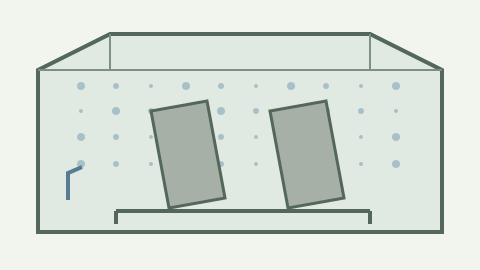
ASTM G48 and ASTM B117: exposure environments
ASTM G48: specimen in ferric chloride solution

ASTM B117: specimens in controlled salt spray
4. What Are Pitting and Crevice Corrosion?
Pitting corrosion is a form of localised attack affecting particular surface locations.
Crevice corrosion is associated with confined regions where local environmental conditions may change.
Stainless steel corrosion resistance is closely associated with its protective chromium-rich passive film.
Localised corrosion may occur when the protective surface condition breaks down in a particular area.
Pitting can be influenced by chloride exposure, alloy composition, surface contamination and environmental conditions.
Crevice corrosion may develop in confined regions such as gasket contacts and narrow joints.
Consequently, components made from the same stainless steel grade may exhibit different corrosion behaviour depending on their surface condition and operating environment.
ASTM G48 provides methods for comparing susceptibility to these forms of localised corrosion under specified test conditions.
5. Can Salt Spray Testing Predict Actual Service Life?
ASTM B117 provides a controlled exposure environment, but real-world conditions are often more complex.
Actual service may involve temperature changes, wet-dry cycles, different contaminants and material contact conditions.
Salt spray results alone therefore cannot reliably predict service life in marine, outdoor or industrial environments.
The method is useful for specified comparative testing, quality control and agreed acceptance programmes.
The selected test should reflect the corrosion mechanism and performance requirement of the application.
6. How Does Surface Roughness Affect Corrosion Resistance?
Surface roughness is one factor influencing stainless steel surface quality.
Microscopic irregularities and machining marks may create locations where moisture, contaminants and corrosive media accumulate.
Reducing surface roughness can refine the microscopic surface condition and reduce some contamination-retaining features.
Under otherwise comparable conditions, a smoother surface generally supports improved cleanability and may enhance corrosion performance.
However, corrosion resistance also depends on alloy grade, passive condition, contamination and service environment.
ASTM G48 recognises that specimen surface preparation can significantly influence results.
Meaningful comparisons therefore require consistent materials, specimen preparation and test conditions.
Microscopic surface texture comparison
Initial rough surface: machining marks and larger peaks and valleys

Refined surface concept: reduced height variations

7. How Does SMT Relate to Corrosion Testing?
Stainless Steel Micro Treatment (SMT) is KUN-QI's specialist stainless steel surface treatment technology.
SMT focuses on refining microscopic surface characteristics and meeting customer-specified Ra surface roughness requirements through whole-component treatment.
KUN-QI's SMT technology can achieve the customer-specified target Ra value or a lower surface roughness value.
SMT is applied to the entire component rather than selected local areas.
By improving microscopic surface characteristics and reducing roughness, SMT can reduce certain features that retain moisture, contaminants and corrosive media, helping to improve cleanability and potentially corrosion performance.
Stainless steel components treated with SMT can be evaluated using applicable ASTM G48 or ASTM B117 test procedures and compared with other surface conditions under consistent material, specimen preparation and testing conditions.
Where customers specify the same corrosion testing requirements, SMT-treated components can undergo testing under the same conditions and acceptance criteria.
Whether a component meets those requirements must be established through actual test results.
ASTM G48 and ASTM B117 are corrosion testing standards rather than SMT processing specifications.
An Ra measurement does not replace a corrosion test result.
8. How Should Corrosion Testing Be Specified?
Technical drawings and purchasing documents should identify:
- Stainless steel grade.
- Applicable ASTM standard and edition.
- Selected ASTM G48 method or ASTM B117 exposure requirements.
- Specimen and component surface condition.
- Applicable exposure duration or other test conditions.
- Corrosion assessment and acceptance criteria.
- Any separately specified Ra requirement.
- Required test reports.
Simply stating “pass salt spray testing” or “comply with ASTM G48” may be insufficient without these details.
The same specification principles apply to SMT-treated components to ensure meaningful evaluation and comparison.
9. Frequently Asked Questions
Are ASTM G48 and ASTM B117 interchangeable?
No. They have different purposes and exposure environments.
Does ASTM G48 only evaluate pitting corrosion?
No. It includes methods addressing both pitting and crevice corrosion.
Does ASTM B117 specify a universal number of passing hours?
No. Exposure periods and acceptance requirements must be specified separately.
Do more salt spray hours always mean longer service life?
No. Salt spray exposure cannot be directly converted into real-world service life.
Can lower Ra improve corrosion resistance?
It may improve cleanability and corrosion performance under comparable conditions, but material and environmental factors must also be considered.
Can SMT-treated components undergo ASTM G48 or ASTM B117 testing?
Yes. SMT-treated stainless steel components can be evaluated using applicable ASTM G48 or ASTM B117 procedures, with results assessed against specified acceptance criteria.
Is SMT an ASTM G48 or ASTM B117 process?
No. SMT is KUN-QI's surface treatment technology, while the ASTM documents address corrosion testing.
10. KUN-QI Professional Stainless Steel Surface Treatment
KUN-QI specialises in stainless steel surface treatment, with Stainless Steel Micro Treatment (SMT) as its core technology.
SMT focuses on refining microscopic surface condition and reducing roughness to meet specified surface quality requirements.
KUN-QI evaluates customer-supplied components according to material, initial surface condition, target Ra, geometry and acceptance criteria.
Services include single-piece prototypes, low-volume orders and varied specialist B2B surface treatment requirements.
SMT-treated components can be evaluated using customer-specified ASTM G48, ASTM B117 or other applicable corrosion test procedures, with compliance determined under the agreed testing conditions and acceptance criteria.
Customers are welcome to provide material grades, drawings, target Ra values, intended service conditions and corrosion testing requirements for technical discussion.
Official Technical References
ASTM G48 — https://store.astm.org/standards/g48
ASTM B117 — https://store.astm.org/standards/b117
Technical note: This article provides a technical explanation of corrosion testing standards and does not replace the official ASTM documents. Compliance with specified acceptance criteria must be supported by actual test results.
Version check: 29 October 2026. ASTM lists ASTM G48-25 and ASTM B117-26a as active. The applicable test edition and procedures remain subject to the customer specification.